Hospital resilience / Technical guide
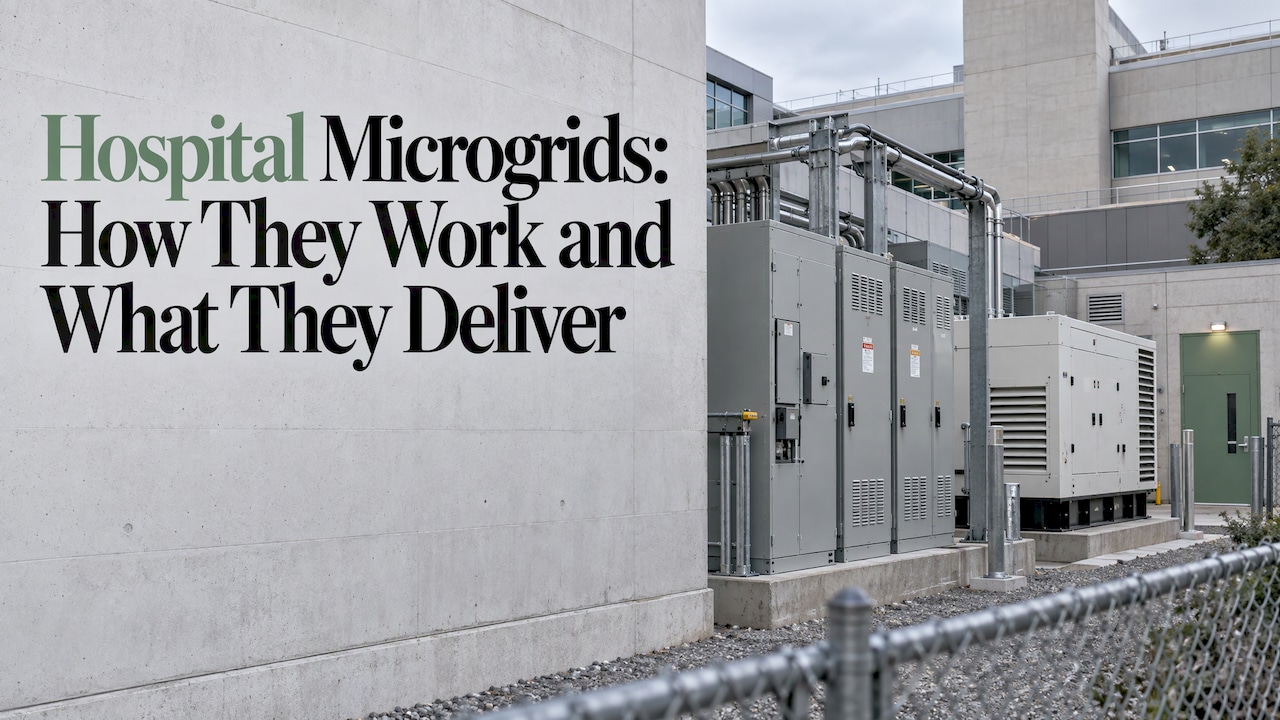
Hospital microgrids: How they work and what they deliver
A hospital microgrid is a local energy system—made of generation, storage, and a smart controller—that serves a hospital campus and can disconnect from the utility grid to keep power on during an outage. It does more than a backup generator because it also runs every day to manage cost, emissions, and reliability. This guide explains how it works, what goes into one, what documented projects show, what the approval path looks like, and how to plan one for your site.
THE SHORT VERSION
TL;DR
- A hospital microgrid combines on-site generation, storage, and a controller. It can island from the grid in an outage and works around the clock when the grid is up.
- Typical building blocks include solar, batteries or thermal storage, combined heat and power, wind, fuel cells, and engine generators.
- Published projects and studies report savings on utility costs and strong coverage of life-critical loads, with results that depend on site design.
- Approval runs through regulations, the utility, the building department, and the state health facilities office. Federal rules now allow alternate emergency power sources in many facility types.
- The best design starts from the local resource mix and the hospital’s load tiers, not from a standard product.
01 / DEFINITION
What a hospital microgrid is
The California Department of Health Care Access and Information (HCAI) describes a microgrid as a self-sufficient energy system serving a discrete footprint, such as a hospital site, using distributed energy resources and often battery storage. It can disconnect from the central grid and operate independently.
Three ideas define it:
- A clear boundary. The microgrid serves a defined set of buildings and loads, such as a main hospital, a central plant, and a medical office building.
- Local resources. Power is produced close to where it is used, rather than only pulled from distant plants.
- The ability to island. When the utility fails, the system separates from it and keeps serving the site.
How it differs from conventional backup power
A standard backup system waits. Generators start when the grid drops and stay idle the rest of the time. The same HCAI white paper notes that simple backup generators are used only in emergencies, while a microgrid operates 24/7/365 managing and supplying energy.
That daily duty matters for reliability. A system that is exercised and managed every day is one the operator understands well. Backup-only setups have a record that shows the exposure: a 2018 legal and industry review reports that during the 2003 blackout, half of New York City’s 58 hospitals had failures in their backup generators.
There is an efficiency angle too. The HCAI paper states that as much as 8 to 15 percent of electricity dissipates in transit across the central grid, and that generating power close to the point of use overcomes this inefficiency.
02 / OPERATING MODES
How it runs: grid-connected and island mode
The microgrid controller is the central brain. HCAI compares it to a conductor: it manages generators, batteries, and nearby building energy systems and orchestrates them toward goals such as lowest price, cleanest energy, or greatest reliability.
When the utility is available
In grid-connected mode, the controller decides each hour where power should come from. According to the same paper, it may buy grid power when prices are low and use solar to charge batteries, then discharge those batteries when grid power is expensive. The hospital gains value every day, not only during emergencies.
When the utility goes down
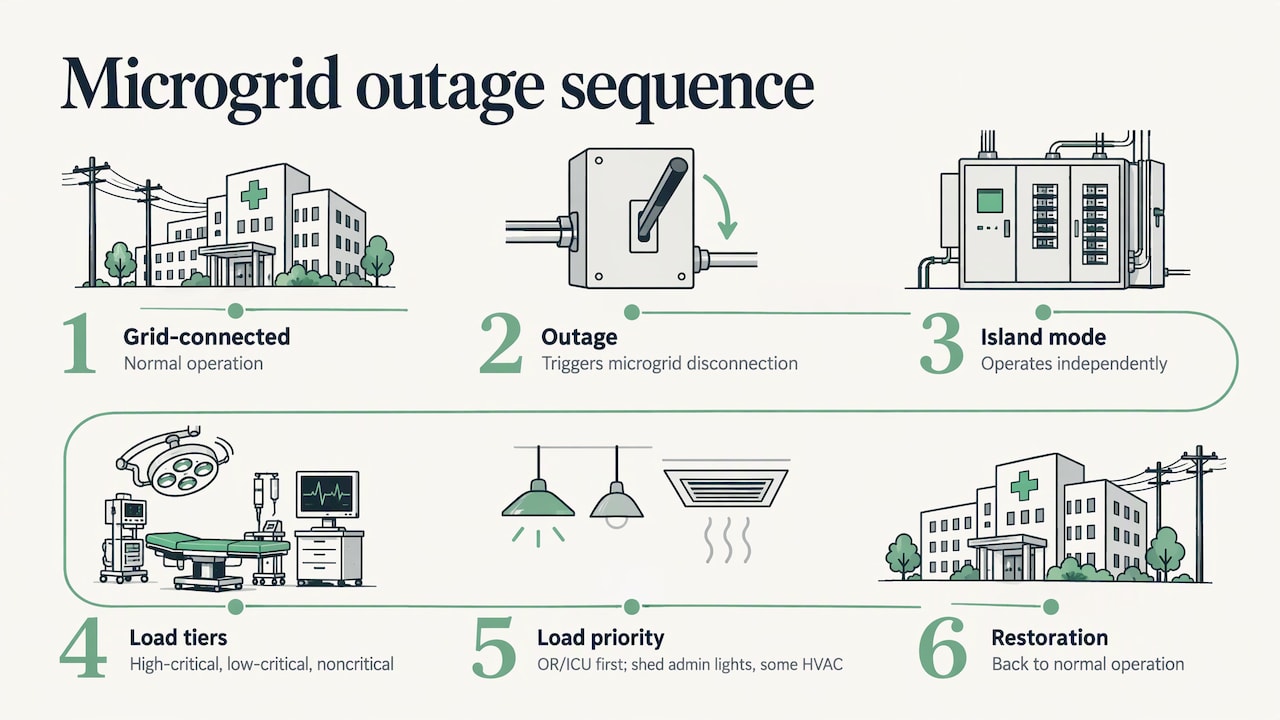
When an outage hits, the microgrid disconnects from the central grid and operates independently. HCAI’s advisory guide says the final approval step includes developing a sequence of events for transitioning from normal operation to island mode and back. That sequence is worth rehearsing with facilities staff because it defines who does what when the lights flicker.
The controller can also manage power for the hospital’s life-safety emergency power branch, and it prioritizes loads. Research on a modeled hospital microgrid describes tiers of need: high-critical, low-critical, and noncritical loads, with the controller optimizing power flow across those tiers. Operating rooms, ICU equipment, and life-safety systems come first. Lighting in administrative wings and some HVAC zones can be shed when supply is tight.
03 / SYSTEM COMPONENTS
What goes into a hospital microgrid
HCAI lists a wide menu of equipment a hospital microgrid can include: solar panels, battery or thermal energy storage, combined heat and power, wind power, fuel cells, and reciprocating engine generators, all coordinated by the controller.
| Component | Role in the hospital | Notes |
|---|---|---|
| Solar PV | Daytime generation, battery charging | Rooftops, canopies, nearby land |
| Battery or thermal storage | Shifts energy in time, bridges outages | Sizing drives outage endurance |
| Combined heat and power | Electricity plus heat for sterilization, hot water, space heating | Suits hospitals’ constant thermal demand |
| Wind | Added generation where the resource exists | Site dependent |
| Fuel cells | Steady, quiet generation | Often fed by gas or biogas |
| Engine generators | Firm backup and extended-duration support | Can stay as a supplement |
| Controller | Dispatches everything, handles islanding | The central brain |
A hospital is an unusually good fit for this mix because it needs power and heat all day and all night. A site that can pair electricity with thermal infrastructure wastes less and relies less on any single source.
04 / DOCUMENTED RESULTS
What documented projects and studies show
Numbers from real projects and peer-reviewed studies give a grounded picture of what to expect. Results vary with climate, tariffs, load, and design, so treat them as examples of what well-designed systems have reported, not guarantees.
Cost savings and resilience in the literature
A 2026 Scientific Reports study using the National Renewable Energy Laboratory’s REopt platform found net present cost savings of 14 percent for the financial optimization scenario and 9 to 14.2 percent across resilience-constrained scenarios, compared with full grid dependence. Adding resilience requirements cost between 0.4 and 2.4 percent of net present cost relative to the financial-only design. In plain terms, in that modeled case, resilience came at a small premium on top of a design that already saved money.
Two more findings from the same study are useful for planners. Systems designed around summer outages yield higher savings because more solar is available, and a deliberate deep-discharge protocol for the battery during emergencies is crucial for cost-effectiveness.
A separate 2026 study in PMC, on a resilience-oriented optimization framework combining PV, multi-node battery storage, and medical load prioritization, reports that coordinated storage placement reduced Energy Not Supplied by 55 to 63 percent versus baseline configurations, while holding at least 95 percent supply to life-critical loads across most simulated outages. It also identifies storage capacity, PV penetration, and outage duration as the dominant factors in resilience.
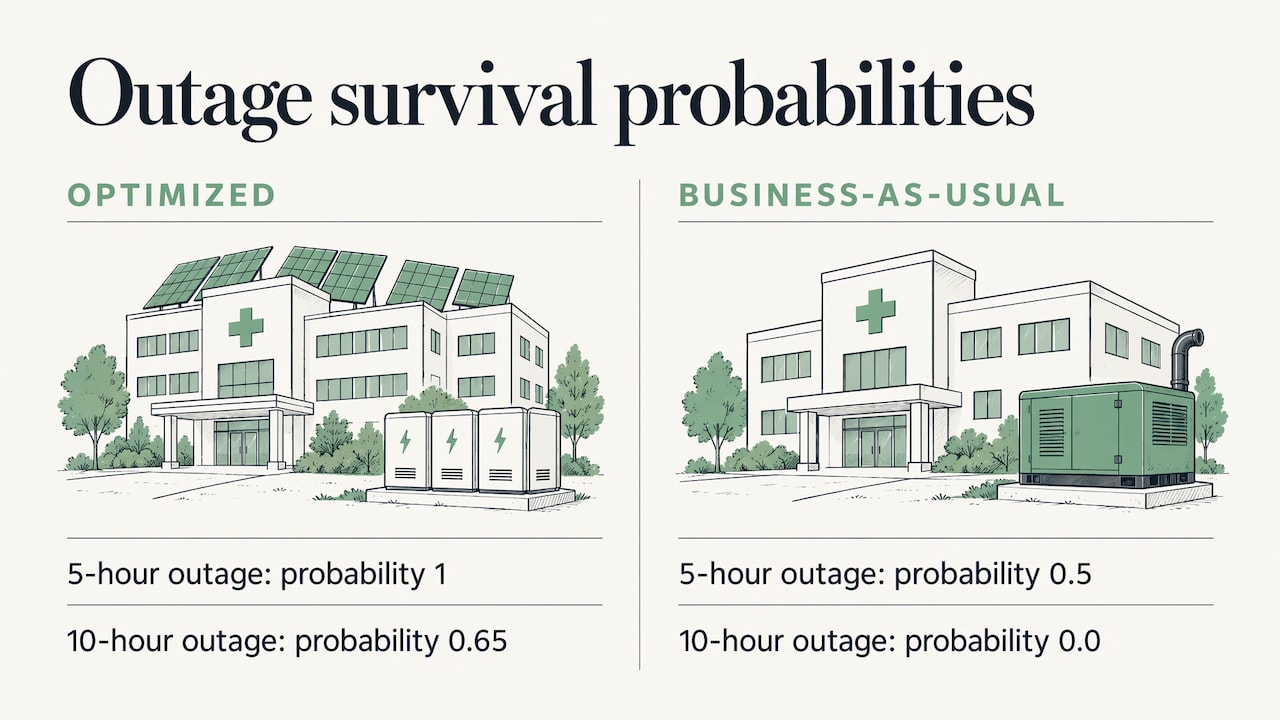
A 2023 study from the U.S. Department of Energy’s OSTI library looked at a hospital in South Africa. It found that the optimized system could sustain five-hour outages with probability 1 and ten-hour outages with probability 0.65, against 0.5 and 0.0 in a business-as-usual case. The lesson travels: the duration of outage you want to cover shapes the design and the odds.
Projects on the ground
| Project | Design | Reported result |
|---|---|---|
| Kaiser Permanente Richmond, California | Renewable microgrid with a controller for generation, storage, delivery, and islanding | Projected savings of nearly 20 percent of baseline utility cost per year; supports life and safety functions for three hours or longer, supplementing existing backup |
| Kaiser Permanente Ontario, California | 9 MWh, 10-hour flow battery with solar PV and a controller; full permission to operate granted in early 2025 | Up to 4.1 GWh of clean energy a year, with estimated annual savings of $328,000 or $9.84 million over the system’s lifetime |
| Gundersen Health System, Onalaska, Wisconsin | New backup energy storage combined with existing solar panels and a landfill gas-to-energy project | Aims to be one of the first 100 percent resilient and renewable energy healthcare campuses in the U.S. |
Notice the pattern. Each project works from what the site already has: rooftop space, a nearby landfill gas source, an existing backup plant. That is the heart of good microgrid design.
05 / COMPLIANCE PATH
Rules, permits and approvals
Hospitals are among the most regulated buildings in the country, so the approval path deserves planning from day one.
Federal flexibility on emergency power
The Centers for Medicare & Medicaid Services issued a categorical waiver allowing new and existing health care facilities to use alternate sources of power other than a generator set or battery system, in accordance with the 2021 edition of NFPA 99 and the 2023 edition of NFPA 70. There is one exception. Nursing homes that use life support systems must still provide an emergency generator under 42 CFR §483.90(c)(2), and other sources are not permitted for that purpose in those facilities.
The California process as a model
California has published the most detailed public roadmap. The HCAI Healthcare Microgrids Advisory Guide (April 2025) lays out five steps:
- Review the relevant regulations, standards, and Title 24 requirements.
- Make initial contact with the California Air Resources Board, the local utility, the local building department, and the state hospital building office.
- Submit plans and obtain all approvals needed for permitting.
- Construct and commission the system.
- Receive final approval, including a documented sequence for moving between normal operation and island mode.
The full process is in the HCAI advisory guide. Requirements outside California differ by state and utility, so confirm local rules with your authority having jurisdiction early. The Richmond project page also notes that the work helps inform the discussion on diesel backup requirements for healthcare facilities, and that regulators and developers are forging new methods and standards for resilient, autonomous critical facilities. The rules are moving in a favorable direction.
06 / PLANNING SEQUENCE
How to plan a hospital microgrid
A workable plan follows a clear order. Skipping steps is where projects stall.
- Map the loads. Sort them into life-critical, low-critical, and noncritical tiers. Record peak and average demand, plus thermal demand for heating, hot water, and sterilization.
- Set the outage target. Decide how many hours or days of islanded operation the campus needs. Studies show that outage duration, storage size, and solar share drive resilience most.
- Inventory local resources. Check roof and land area for solar, wind exposure, nearby water flow or heat sources, and any biogas. Existing assets such as a central plant or backup units can stay in the design.
- Choose the mix. Pair resources so they cover each other’s gaps: solar by day, steady sources overnight, storage between.
- Define the control strategy. Decide what the controller optimizes day to day, how it prioritizes loads in an outage, and how batteries are discharged in an emergency.
- Engage regulators and the utility early. Interconnection and facility approvals set the schedule more than construction does.
- Commission and rehearse. Test the transition to island mode and back with facilities and clinical leadership.
07 / POWER PASTURE™ PERSPECTIVE
Perspective
Most hospital microgrid conversations start with a battery and a generator. We start with the site. Every campus sits on a different set of local resources, and the strongest systems are the ones built around them.
At Power Pasture™ we design site-specific systems that pair geothermal, hydro, solar, and wind according to what is actually available near the hospital. Our approach is meant to deliver stable, 24/7 operation, because a hospital cannot ask the sun or the wind to keep a schedule. Steady sources carry the base load, variable sources add volume, and the energy and thermal plans are developed together.
We also believe in modular scaling. A hospital grows: a new wing, a new imaging suite, a new central plant. An energy system that can grow in steps with the campus protects the original investment and keeps reliability intact as demand rises.
The projects above show that regulators, utilities, and health systems are now comfortable with renewable-led resilience. The next step is fitting that resilience to each place, and that is the work we do.
— Dylan
YOUR SITE / YOUR ENERGY PLAN
Work with Power Pasture™ on your site
If you operate a hospital or a power-intensive campus, we design and implement custom renewable energy infrastructure that combines geothermal, hydro, solar, and wind into a system suited to your local conditions. Our focus is high-density, dispatchable generation with stable 24/7 operation, scaled in modules as your needs grow, and integrated with thermal infrastructure.
To discuss how a site-specific system could fit your facility, see our local renewable energy infrastructure offer. Pricing is project-based and depends on your site, so the starting point is a conversation about your loads and local resources.
08 / COMMON QUESTIONS
FAQ
Is a hospital microgrid the same as a backup generator?
No. A backup generator sits idle until an outage. A microgrid is a managed system of generation, storage, and controls that runs all the time and can island from the grid when needed. A generator can still be one of its components.
What can power a hospital microgrid?
Per the California HCAI white paper, options include solar, battery or thermal storage, combined heat and power, wind, fuel cells, and engine generators. The right mix depends on the resources near your site and on your outage target. Controllers coordinate these sources and prioritize critical loads.
Can a hospital microgrid save money?
Published work suggests it can. A 2026 modeling study reported net present cost savings of 9 to 14.2 percent in resilience-constrained designs versus full grid dependence, and the Kaiser Permanente Richmond project projects nearly 20 percent savings on baseline utility cost. Actual results depend on tariffs, load, and design.
Do federal rules allow sources other than generators for emergency power?
In many facility types, yes. A 2023 CMS categorical waiver permits alternate emergency power sources in line with NFPA 99 (2021) and NFPA 70 (2023). Nursing homes using life support systems are the exception and must keep an emergency generator.
How long does a hospital microgrid take to approve?
It varies by state, utility, and project size. The path generally runs through regulatory review, early contact with the utility and building authorities, plan approval, construction and commissioning, and final approval. Start those conversations first, since they often set the timeline.
09 / REFERENCES
Sources
- Microgrids for Healthcare Facilities, California HCAI white paper (2021)
- Healthcare Microgrids Advisory Guide, California HCAI (2025)
- Potential benefits of microgrids for hospitals, Bricker (2018)
- Techno-economic analysis and resilience enhancement of a hospital microgrid, Scientific Reports (2026)
- Resilience-oriented optimization of hospital microgrids, PMC (2026)
- Optimizing design and dispatch of a resilient renewable hospital microgrid, OSTI (2023)
- Renewable Microgrid for a Medical Center, CEC Energize Innovation Fund
- Essential Power Support for Kaiser Permanente Ontario Medical Center, CEC Energize Innovation Fund
- Microgrid Technology, Gundersen Sustainability
- CMS QSO-23-11-LSC categorical waiver (2023)