Critical power / Planning guide
Energy resilience: How to keep critical power on
Energy resilience is the ability of an energy system to withstand a severe disruption, keep essential functions running, and recover quickly afterward. For a data center, a hospital, a plant, or a growing community, it comes down to one question: when the grid, the fuel supply, or the weather fails, what keeps the lights on?
THE SHORT VERSION
TL;DR
- Energy resilience means coping with rare, severe disruptions and restoring power fast. It goes beyond everyday reliability.
- Resilient power systems rely on diversity, redundancy, local generation, and planning that starts at the design stage—not as a retrofit.
- Data centers, manufacturers, and hospitals are the sites where an outage costs the most, and each has proven options such as microgrids and combined heat and power.
- Matching generation to local resources—such as geothermal, hydro, solar, and wind—helps a site avoid depending on one point of failure.
- Start with a risk assessment of your own site: hazards, single points of failure, fuel, controls, and staff.
01 / DEFINITION
What energy resilience means
Definitions differ slightly by field, but they agree on the core idea. A review of energy system resilience describes it as the capacity of an energy system to cope with a hazardous event or trend while keeping its essential functions, plus the capacity to adapt, learn, and transform. It breaks resilience down into robustness, resourcefulness, and recovery.
The State of Oregon's Energy Resilience 101 frames it across the whole chain, from production through delivery to end users: the ability to withstand and rapidly restore energy delivery after non-routine disruptions of severe impact or duration.
CIGRE defines power-system resilience as the ability to limit the extent, severity, and duration of system degradation after an extreme event through anticipation, preparation, absorption, adaptation, rapid recovery, and sustained operation of critical functions.
At community scale, the Pacific Northwest National Laboratory's planning guide says community energy resilience means people stay healthy and safe even when supply is interrupted. That covers keeping energy flowing, keeping people safe during outages, and getting the grid and local economy back up quickly.
How the related terms fit together
Resilient power systems, resilient energy systems, and energy-system resilience all point to the same core idea. “Power” usually means electricity and the equipment that delivers it. “Energy” is broader and includes heat, fuels, and the thermal side of a facility. A resilient energy system treats electricity and heat together, which matters for hospitals and manufacturers where thermal loads are large.
02 / RELATED TERMS
Resilience, reliability, efficiency, and security
These words get mixed up, and the difference shapes design decisions.
Reliability is about typical disruptions. Oregon's guidance describes reliability as the ability to withstand and recover from routine problems, and treats resilience as a subset of energy security. A site can have a very reliable grid connection and still be unprepared for a week-long regional event.
Security traditionally focuses on supply risk, such as fuel access and price. A 2025 UCL paper on resilience and preparedness argues that resilience goes beyond energy security. It also covers the ability to anticipate, adapt to, and recover from complex, interconnected, and often unpredictable disruptions.
Efficiency is about using less energy for the same output. It is a different goal, but the two reinforce each other. The U.S. Climate Resilience for Health Care Toolkit recommends efficient building equipment specifically to extend backup-power runtime.
| Concept | Question it answers | Typical scope |
|---|---|---|
| Reliability | How often does power fail in normal conditions? | Routine faults, short outages |
| Efficiency | How much energy do we need? | Equipment, buildings, processes |
| Security | Can we access supply at stable cost? | Fuel and supply chains |
| Resilience | Can we keep essential functions and recover after a severe event? | Extreme events, long outages |
03 / THREATS + WEAK LINKS
What threatens energy systems
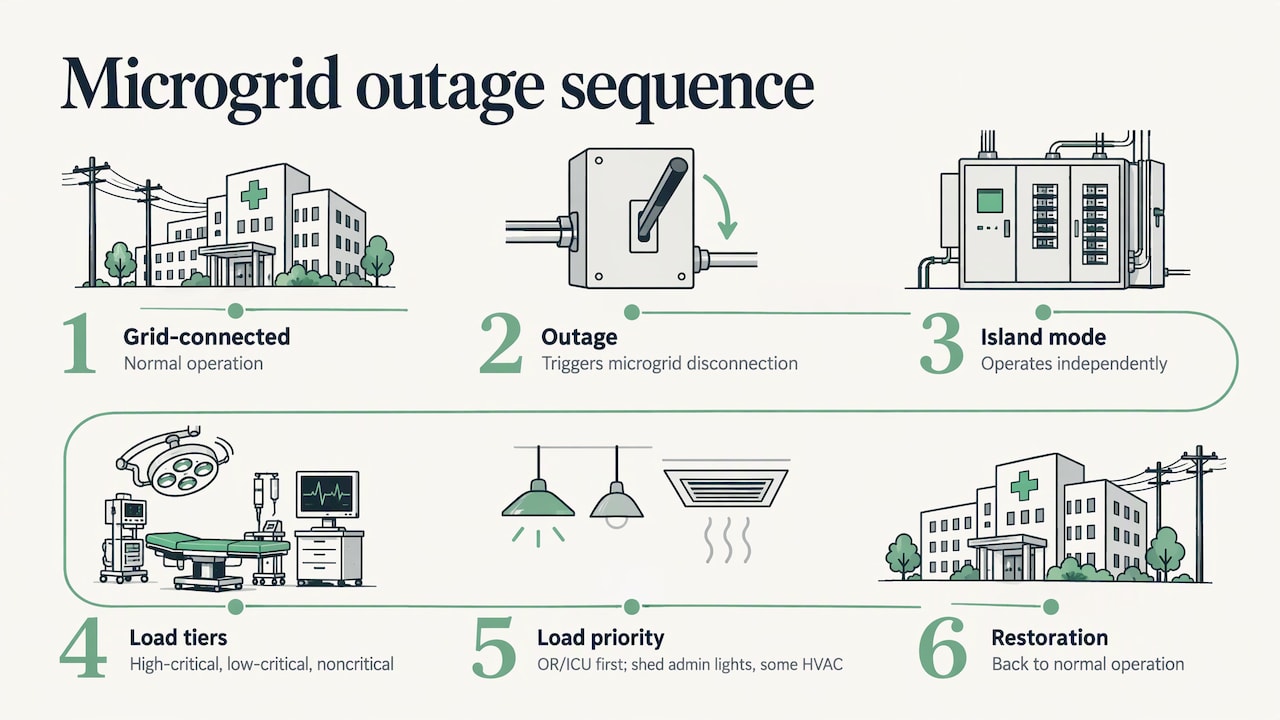
The National Renewable Energy Laboratory's microgrid guide lists natural and human-caused hazards, including wildfires, hurricanes, storm surge, and cyberattacks. It also names the site vulnerabilities that matter in design:
- Locations prone to flooding or fire
- No backup systems, or single points of failure in electrical lines
- Poles and lines in disrepair
- Vulnerable fuel supply chains
- No redundant communication systems
- Weak cybersecurity defenses
- Too few staff who know how to operate the system
A 2023 review of power-system resilience adds earthquakes, snowstorms, physical attacks, and operator missteps. The practical lesson is that most outages that hurt are not exotic. They come from a single weak link: one feeder, one fuel-delivery route, or one control system. Resilience work starts by finding those links on your own site.
04 / DESIGN MEASURES
Measures that make power systems resilient
The International Energy Agency's Energy System Resilience report recommends putting resilience at the center of energy planning. Its measures include hardening infrastructure, building emergency-response and communication capabilities, using distributed resources, standardizing and stockpiling critical equipment, treating data as a strategic asset, and embedding cyber resilience.
The National Academies make a useful distinction in Enhancing the Resilience of the Nation's Electricity System. Some actions make the system more robust, such as wind-resistant steel or concrete poles instead of wood. Others make recovery more effective, such as preemptively powering down parts of the system to limit damage. A good plan uses both, and it needs organizational readiness as well as hardware.
Diversity and redundancy
RMI's Clean Energy 101 names the principles of resilient systems: diversity and redundancy, simple passive and flexible design, and use of locally available renewable or reclaimed resources. A site fed by geothermal, hydro, solar, and wind does not lose everything when one resource has a bad week.
Local generation
A 2025 paper on community energy finds that it strengthens resilience by diversifying supply and embedding infrastructure in local contexts. The main benefits are localized generation, built-in redundancy, and a wider mix of energy resources.
Heat and power together
The EPA's CHP project-development guide notes that combined heat and power systems are typically sized to a facility's year-round baseload thermal demand. In a hybrid CHP system or microgrid, CHP can provide 24/7 resilience while allowing on-site renewables and greater emissions reductions.
Plan early
The IEA argues that resilience built in at the planning stage—through holistic risk assessments involving operators, regulators, and energy ministries—reduces overall cost compared with retrofitting. Resilient designs also return to normal operation far faster during extreme events.
05 / CRITICAL APPLICATIONS
Who needs it most
Data centers
Demand is rising quickly. The IEA's Energy and AI analysis projects that global data-center electricity demand will more than double by 2030, to around 945 TWh. In the United States, data centers are on course to account for almost half of electricity-demand growth between 2025 and 2030.
The IEA's energy-supply analysis shows renewables supply about 27% of data-center electricity today and could meet nearly half of the additional demand through 2030. Oak Ridge National Laboratory's guide to CHP in critical infrastructure says CHP at data centers ranges from a few hundred kilowatts up to 10 MW. Such systems need black-start capability, independent grid operation, ample carrying capacity, and controls for parallel utility interconnection.
Manufacturers
The same ORNL guide says critical manufacturing facilities are ideal candidates for CHP because they have coincident power and thermal loads and long operating hours. Industrial facilities make up about 86% of existing CHP capacity in the United States. For a plant, a power loss means scrapped batches, idle crews, and missed shipments, so on-site, high-density generation is a natural resilience tool.
Hospitals
The stakes are highest in health care. A November 2025 Lancet Planetary Health analysis of evidence from nearly a thousand hospitals found outages were common, especially in lower-income settings. They disrupted surgery, diagnostics, cold chains, and digital records, with reports of direct patient harm. The authors recommend moving from diesel-only backup to context-appropriate on-site renewables with storage, integrated with stable grids and smart switching.
Growing communities
New housing and commercial developments have a rare advantage: the energy system can be designed with the buildings. Community-energy research shows that local governance can also speed crisis response and widen the number of people able to act during an outage. Planning for a development should cover critical loads such as water, communications, and emergency services first.
06 / SITE PLANNING
How to plan a resilient system for your site
- Map critical loads. List what must never stop—servers, life-safety systems, process lines, and cold storage—and what can wait.
- Assess hazards and weak links. Check flood and fire exposure, single feeders, fuel logistics, communications, cybersecurity, and staffing.
- Inventory local resources. Geothermal gradients, river or stream flow, solar exposure, and wind regime differ by site. The IEA-EBC Energy Master Planning guide explains that the cost-effective mix depends on climate zone, density of energy users, and local resources.
- Pair resources for steady output. Combine dispatchable and variable sources, and add storage and thermal infrastructure where they fit the load.
- Design for scaling. Modular systems let you add capacity as the site grows.
- Plan operations. Technical readiness rests on organizational readiness. Train staff, rehearse outages, and document restoration steps.
Design factors to build in
The NREL guide notes that microgrids can carry higher upfront capital costs depending on site requirements and existing infrastructure. They also involve more complex controls that need specialized skills, and a larger communications footprint that calls for solid cybersecurity. These are design inputs, not obstacles: budget for skilled operation, secure controls, and maintenance from the first drawing.
07 / OUR PERSPECTIVE
Resilience starts with the site
We see energy resilience as a design decision made at the start of a project, not a backup purchased after a scare. The sites we think about most are data centers, manufacturing facilities, hospitals, and growing communities, where a long outage is not an inconvenience but a serious failure.
Our approach is to integrate geothermal, hydro, solar, and wind into one site-specific system, based on what the local landscape can actually provide. Pairing resources that behave differently gives a site diversity and redundancy. It also lets us aim for high-density, dispatchable generation and stable 24/7 operation rather than depending on a single source or a single fuel line.
We believe energy and thermal infrastructure belong in the same plan. Heat is often as critical as electricity, and designing them together uses existing resources more efficiently. Resilience and sustainability do not have to be traded against each other.
— Dylan
08 / POWER PASTURE FOR RESILIENT INFRASTRUCTURE
Build critical power around the resources at your site
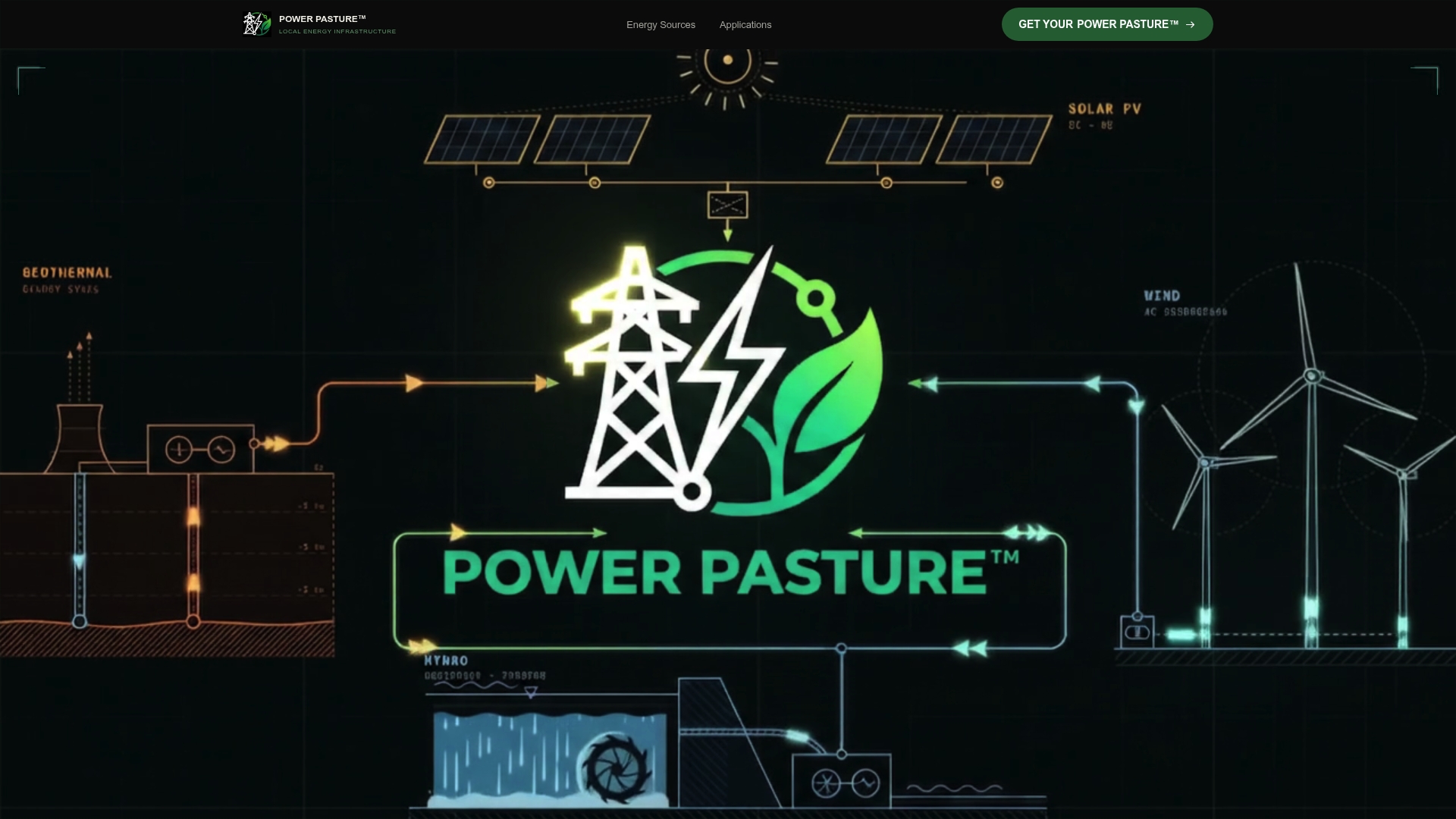
Power Pasture™ designs and implements local renewable energy infrastructure for power-intensive users, including data centers, manufacturing facilities, hospitals, and commercial and residential developments. Each system combines geothermal, hydro, solar, and wind according to the resources available at the site, with modular scaling and an emphasis on stable, round-the-clock operation.
If you operate a site where power cannot fail, tell us about your loads and location.
09 / COMMON QUESTIONS
FAQ
What is the difference between energy efficiency and energy resilience?
Efficiency reduces how much energy a site needs. Resilience is about keeping essential functions running through a severe disruption and recovering quickly. They work together: efficient equipment stretches backup runtime.
What are resilient power systems made of?
They combine diverse generation sources, redundancy, storage, flexible design, and tested operating procedures. Microgrids and combined heat and power are common building blocks. The best mix depends on local resources and the site's critical loads.
Is energy resilience the same as energy security?
Not quite. Energy security centers on managing supply risk. Resilience also covers anticipation, adaptation, continuity of critical functions, and recovery from complex disruptions.
Which facilities need resilient energy systems most?
Those where an outage causes serious harm or loss: hospitals, data centers, manufacturing plants, and critical community services such as water, communications, and emergency response.
Can renewables support resilience?
Yes, when they are well integrated. On-site renewables paired with storage, smart switching, firm resources, and a tested operating plan can reduce dependence on a single feeder or fuel source.
10 / REFERENCES
Sources
- Energy system resilience: a review, ScienceDirect
- Energy Resilience 101, Oregon Energy Info
- Community Energy Resilience Planning Guide, PNNL
- Power-system resilience: definition, features and properties, CIGRE
- Resilience and preparedness in Europe's energy transition, UCL
- Climate Resilience for Health Care Toolkit
- Microgrids for Energy Resilience, NREL
- Review of Power System Resilience Concept, Assessment, and Enhancement, MDPI
- Energy System Resilience executive summary, IEA
- Enhancing the Resilience of the Nation's Electricity System, National Academies
- Clean Energy 101: Energy System Resilience, RMI
- Focus on community energy and infrastructure resilience, IOPscience
- CHP Project Development Steps, U.S. EPA
- AI and data-center electricity demand, IEA
- Energy supply for AI, IEA
- Applying CHP in critical infrastructure, ORNL
- Energy security as a crucial component of health, The Lancet Planetary Health
- Energy Master Planning toward Net Zero Energy Resilient Communities, IEA-EBC